
 ChatGPT
 Perplexity
 Grok
Grok Google AI
 Claude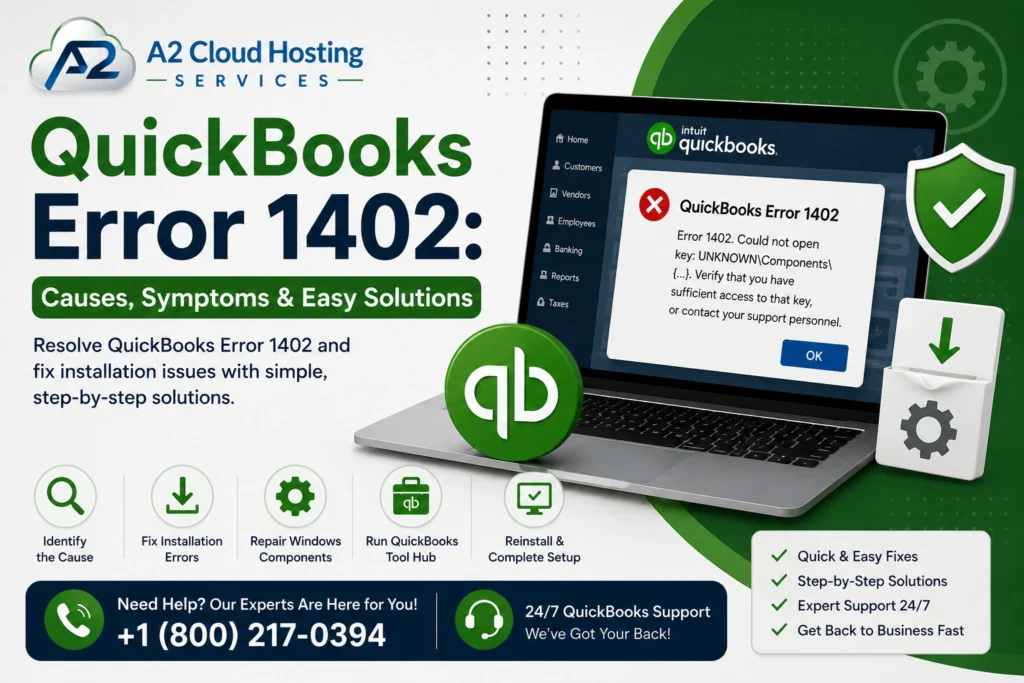
If you have ever tried to install or update QuickBooks Desktop and been stopped by a message that reads Error 1402: Could not open key, you know how abruptly it brings everything to a halt. The installation either freezes, rolls back, or fails to complete, and you are left staring at an error message that offers very little explanation about what actually went wrong or how to fix it.
QuickBooks Error 1402 is what is known as a registry access error. It means that during the installation process, QuickBooks attempted to read or write to a specific key in the Windows Registry — a critical internal database that stores settings and configuration information for your operating system and all installed software — and was denied access. The reasons for that denial can range from simple permission problems to deeper system corruption, and the right fix depends entirely on which of those causes applies to your situation.
This guide walks you through every aspect of Error 1402 in clear, plain language. Whether you are a business owner handling your own system, an IT administrator supporting multiple QuickBooks users, or an accountant troubleshooting a client’s machine, by the end of this article you will have a complete understanding of this error and a step-by-step plan to fix it permanently.
Need Immediate Help? Call our QuickBooks support experts at +1 (800) 217-0394 for fast, professional assistance — available right now.
What Is QuickBooks Error 1402 and What Does It Actually Mean?
QuickBooks Error 1402 is a Windows Installer error that occurs when the QuickBooks installation process attempts to access a registry key it does not have permission to open or modify. The Windows Registry is an enormous, structured database that Windows and all installed applications use to store their settings, configuration data, and operational parameters. Every time you install a program like QuickBooks, the installer reads from and writes to specific registry keys to register the application with your system.
When Error 1402 appears, it means one of two things: either the user account running the installation does not have the permissions required to access a particular registry key, or the registry key itself has been corrupted or is missing the correct access control settings. In either case, the installer cannot proceed, and the installation fails.
The error message you see on screen typically appears in one of these formats:
Error 1402: Could not open key: HKEY_LOCAL_MACHINE\SOFTWARE\Classes\CLSID\{[long alphanumeric code]}. Verify that you have sufficient access to that key, or contact your support personnel.
Error 1402: Could not open key: UNKNOWN\Components\[component ID]. Verify that you have sufficient access to that key, or contact your support personnel.
The specific registry path mentioned in the error message will vary from system to system and from one QuickBooks version to another. However, the core problem is always the same — access to a required registry key has been blocked or is unavailable.
This is not a QuickBooks-only problem. Error 1402 is a generic Windows Installer error that can appear when installing Microsoft Office, Adobe products, and many other enterprise applications. The fact that it appears during a QuickBooks installation simply means the QuickBooks installer encountered a pre-existing registry permission or integrity issue on your particular system.
Recognizing the Symptoms of QuickBooks Error 1402
Before investing time in troubleshooting, it helps to confirm that what you are experiencing is genuinely Error 1402 and not a different installation problem. Here are the most common symptoms associated with this error:
- A dialog box appears during the QuickBooks installation showing the number 1402 and the phrase “Could not open key” followed by a registry path
- The QuickBooks installation stops progressing and then automatically begins rolling back, undoing any changes it had already made
- Your computer becomes noticeably slower or temporarily unresponsive while the installer attempts to access the registry
- Multiple installation attempts fail at the same point in the setup process, with the same or similar error message each time
- QuickBooks was previously working but began showing this error after a Windows update or a system change
- Attempting to repair an existing QuickBooks installation through the Control Panel also triggers the same error
- The error message references a path beginning with HKEY_LOCAL_MACHINE or HKEY_CURRENT_USER, which are both root locations in the Windows Registry
If you are seeing any combination of these symptoms — particularly the 1402 error code alongside a registry path in the message — then the solutions below are designed exactly for your situation.
Why Does QuickBooks Error 1402 Occur? All the Root Causes Explained
Error 1402 does not appear out of nowhere. There are several well-documented causes, and understanding them helps you choose the most appropriate fix rather than working through solutions that do not apply to your situation.
Cause 1: Insufficient Registry Key Permissions
This is the most common cause. Every registry key in Windows has a set of access permissions — similar to file permissions — that control which users and processes can read from or write to it. If the QuickBooks installer is running under a user account that does not have full control over a specific registry key, the installation cannot complete that step and Error 1402 appears.
This situation can arise if the registry key was created by a different user account, if permissions were accidentally changed during a system maintenance process, or if the system was configured with restricted user settings that limit access to certain registry areas.
Cause 2: Corrupted Windows Registry Keys
Registry corruption is another leading cause of Error 1402. The Windows Registry can become corrupted for several reasons — a sudden system shutdown while the registry was being written to, a failed previous installation that left behind incomplete registry entries, malware that modified or deleted registry data, or a problematic registry cleaning tool that removed entries it should not have.
When the registry key that QuickBooks needs to access is corrupted, the installer cannot read it correctly even if it has permission to do so, resulting in the 1402 error.
Cause 3: Damaged Microsoft Components — .NET Framework, MSXML, and Visual C++
QuickBooks Desktop depends on several Microsoft components that are pre-installed on Windows. If the .NET Framework, MSXML (an XML processing library), or Visual C++ Redistributable packages on your system are damaged or outdated, the QuickBooks installer may fail during the steps where it tries to register these components with the Windows Registry — producing Error 1402 in the process.
Cause 4: Incomplete or Failed Previous QuickBooks Installation
If a previous attempt to install QuickBooks was interrupted — due to a power cut, a user cancelling the installation partway through, or a system crash — the partial installation may have left behind corrupted or incomplete registry entries. When you attempt the installation again, the new installer encounters these leftover entries and cannot work with them, triggering the 1402 error.
Cause 5: Interference from Antivirus or Security Software
Security software can prevent the QuickBooks installer from making necessary changes to the Windows Registry. Some antivirus programs monitor registry modification activity and block changes from installers they have not specifically whitelisted. When this happens during the QuickBooks setup, the installer receives an access denied response from Windows, which surfaces as Error 1402.
Cause 6: Outdated Windows Operating System
Running an older version of Windows that has not received recent updates can create gaps in the availability of shared components and security frameworks that QuickBooks relies on. Some Windows updates specifically address registry permission issues and shared component vulnerabilities that are known to cause installation errors like 1402.
Cause 7: Corrupted or Damaged QuickBooks Installer File
If the QuickBooks installer file you are using was downloaded from an unofficial source, was interrupted during download, or became corrupted while stored on a damaged disc or drive, the installer itself may contain errors. A corrupted installer can fail at registry interaction steps even if the underlying Windows system is perfectly healthy.
Cause 8: Background Applications Conflicting with the Installer
Certain applications that run in the background — particularly other software installers, update managers, or registry optimization tools — can lock registry keys while they are actively using them. If the QuickBooks installer tries to access a key that another process has locked, Windows will deny that access and the 1402 error will appear.
Before You Begin Troubleshooting: Two Quick Steps
Before diving into the solutions, complete these two preparatory steps. They do not take long and can save you a lot of trouble later.
Step One: Back Up Your QuickBooks Company Files
Although Error 1402 is an installation error that does not affect your existing data, it is always good practice to back up your QuickBooks company files before performing any major troubleshooting that involves registry edits or system changes. Open QuickBooks if it is currently accessible, go to File, then Back Up Company, and save a copy to an external drive or cloud storage.
Step Two: Run the Reboot.bat File First
Before trying any of the detailed solutions below, Intuit officially recommends running a file called reboot.bat, which is included with QuickBooks. This file re-registers QuickBooks components in the Windows Registry and frequently resolves Error 1402 without requiring any further action. Here is how to find and run it:
- Open File Explorer and navigate to the QuickBooks installation folder, which is usually located at C:\ProgramData\Common Files\Intuit\QuickBooks
- Look for a file named reboot.bat in that folder
- Right-click on reboot.bat and select Run as Administrator
- Wait for the process to complete — a Command Prompt window will open and close automatically
- Once it finishes, restart your computer and attempt the QuickBooks installation or update again
If the reboot.bat file resolves the error, you are done. If the error appears again after running it, proceed to the solutions below.
8 Proven Solutions to Fix QuickBooks Error 1402
Work through these solutions in the order they are presented. Each one addresses a specific potential cause of the error, and the solutions are arranged from simplest to most technical so that most users will find a resolution before reaching the more advanced steps.
Solution 1: Restart Your Computer and Run the Installer as Administrator
A system restart clears temporary files, releases any locked registry keys from background processes, and resets Windows services to a clean state. After restarting, it is essential to run the QuickBooks installer with full administrative rights rather than as a standard user.
To do this, navigate to the QuickBooks installer file, right-click on it, and select Run as Administrator from the context menu. If Windows prompts you with a User Account Control dialog, click Yes to grant the necessary permissions. Then proceed through the installation normally and see if the error appears again.
This simple step resolves the error in a surprising number of cases, particularly when the issue is purely a permissions problem with the user account running the installer.
Solution 2: Update Windows to the Latest Version
Outdated Windows installations often lack the updated security patches and component libraries that QuickBooks requires. Running Windows Update ensures that your system has the most current versions of all shared components, including .NET Framework, MSXML, and Visual C++ Redistributables.
Follow these steps to update Windows:
- Press the Windows key and open Settings
- Navigate to Update and Security, then select Windows Update
- Click Check for Updates and allow Windows to search for all available updates
- Install every available update, including any optional updates that appear in the list
- When prompted, restart your computer to apply the updates
- After the restart, attempt the QuickBooks installation again
If Windows Update itself encounters errors during this process, note the error codes and resolve them before proceeding, as they indicate underlying system issues that will also affect QuickBooks installation.
Solution 3: Run the QuickBooks Install Diagnostic Tool
The QuickBooks Install Diagnostic Tool is an official utility developed by Intuit specifically to detect and repair the types of Windows component issues that cause QuickBooks installation errors. It automatically scans for and fixes problems with .NET Framework, MSXML, Visual C++, and other dependencies without requiring you to manually identify which component is causing the problem.
Here is how to use it:
- Download and install the QuickBooks Tool Hub from Intuit’s official website
- Open the QuickBooks Tool Hub after installation is complete
- Click on the Installation Issues section in the left-hand menu
- Select the QuickBooks Install Diagnostic Tool option
- Allow the tool to run completely — this process typically takes between 10 and 30 minutes and should not be interrupted
- When the diagnostic finishes, restart your computer
- Attempt the QuickBooks installation again and check whether Error 1402 reappears
Because this tool was specifically designed for QuickBooks installation problems, it is one of the most reliable first steps and resolves the issue for a large percentage of users.
Solution 4: Fix Registry Key Permissions Manually
If Error 1402 is caused by a registry key with incorrect permissions, you can manually correct those permissions using the Windows Registry Editor. This is a more advanced step, but it is well-documented and straightforward to follow if you proceed carefully.
Important Warning: Making incorrect changes to the Windows Registry can cause serious system problems. Follow these steps precisely and do not modify any registry keys other than the specific one mentioned in your error message. If you are not comfortable editing the registry, skip to Solution 5 or call +1 (800) 217-0394 for expert assistance.
Follow these steps:
- Press Windows + R to open the Run dialog, type regedit, and press Enter to open the Registry Editor
- In the Registry Editor, note the exact registry path shown in your Error 1402 message — it will look something like HKEY_LOCAL_MACHINE\SOFTWARE\Classes\CLSID\{long ID}
- Navigate to that path in the Registry Editor by expanding the folders in the left-hand panel
- Once you have found the registry key, right-click on it and select Permissions from the context menu
- In the Permissions window, click on Administrators in the list of Group or user names
- In the permissions section at the bottom, check the box next to Allow for Full Control
- Click Apply, then click OK to save the changes
- Repeat the same process for any parent keys in the path if the error message mentions multiple keys
- Close the Registry Editor, restart your computer, and try the QuickBooks installation again
Once the correct permissions are restored, the QuickBooks installer should be able to access the key without any further issues.
Solution 5: Temporarily Disable Antivirus and Firewall Software
If your security software has been blocking the QuickBooks installer from accessing or modifying registry keys, temporarily disabling it during the installation will allow the process to complete without interference.
Here is how to do this safely:
- Open your antivirus program and look for an option to temporarily disable real-time protection or to pause the program
- Open Windows Security from the Start menu, go to Firewall and Network Protection, and turn off the firewall for your active network profile
- With security software paused, right-click the QuickBooks installer and select Run as Administrator
- Complete the installation process without interruption
- As soon as the installation finishes, immediately re-enable your antivirus and Windows Firewall
Security Reminder: Disabling your antivirus is a temporary diagnostic measure only. Never browse the internet or open email while your security software is disabled. Re-enable it immediately after QuickBooks finishes installing. For a permanent fix that does not require disabling security software, add the QuickBooks installation folders to your antivirus exclusion list.
Solution 6: Repair or Reinstall Microsoft .NET Framework and Visual C++
Since damaged .NET Framework or Visual C++ Redistributable packages are a known cause of Error 1402, repairing these components directly can resolve the issue even when other approaches have not worked.
To repair .NET Framework through Windows Features:
- Open the Control Panel and navigate to Programs, then Programs and Features
- Click on Turn Windows Features On or Off in the left-hand panel
- Look for Microsoft .NET Framework entries in the list that appears
- If any entry is unchecked, check it and click OK to install the missing component
- If all entries are already checked, try unchecking them, clicking OK, restarting your computer, and then going back and re-enabling them — this forces a repair of the component
To reinstall Visual C++ Redistributables:
- Open the Control Panel, go to Programs and Features
- Look for all entries labeled Microsoft Visual C++ Redistributable in the installed programs list
- Uninstall each one in turn, restarting your computer after removing them all
- Download the latest Visual C++ Redistributable packages from the official Microsoft website — download both the x64 and x86 versions
- Install the downloaded packages and restart your computer
- Attempt the QuickBooks installation again
Solution 7: Run the System File Checker Tool
Windows includes a built-in diagnostic tool called the System File Checker that scans all protected Windows system files and replaces corrupted or missing files with healthy cached versions. If registry permission issues stem from underlying Windows file corruption, this tool addresses the root of the problem.
Here is how to run it:
- Press the Windows key and type cmd in the search bar
- Right-click on Command Prompt in the results and select Run as Administrator
- In the Command Prompt window, type sfc /scannow and press Enter
- Allow the scan to run completely without closing the window — it typically takes 15 to 30 minutes
- Once the scan is complete, you will see a result message indicating whether issues were found and repaired
- Restart your computer regardless of the scan result
- After the restart, attempt the QuickBooks installation again
If the System File Checker reports that it found corrupted files it could not repair, run the Deployment Image Servicing and Management command as a follow-up. Open Command Prompt as Administrator and type DISM /Online /Cleanup-Image /RestoreHealth then press Enter. This command connects to Windows Update servers to download and replace corrupted system files that the SFC tool could not handle on its own.
Solution 8: Perform a Clean Installation of QuickBooks
If all previous solutions have failed to resolve Error 1402, the issue may be rooted in a corrupted or incomplete QuickBooks installation that has left behind conflicting registry entries and files. A clean installation removes every trace of QuickBooks from your system before reinstalling it fresh, which eliminates the corrupted data that has been causing the error.
Follow these steps carefully:
- Write down your QuickBooks product key and license number before proceeding — you will need these to activate QuickBooks after reinstalling
- Download the QuickBooks Clean Install Tool from the official Intuit website
- Run the Clean Install Tool, select your version and year of QuickBooks, and follow the on-screen instructions to perform a complete removal
- After the Clean Install Tool finishes, restart your computer
- Download a fresh copy of the QuickBooks installer from Intuit’s official website — do not reuse the installer file you previously downloaded, as it may itself be corrupted
- Run the fresh installer as Administrator and follow the installation steps
- Enter your product key and license number when prompted to activate QuickBooks
- Once installation is complete, restart your computer and open QuickBooks to confirm everything is working correctly
The clean installation approach removes all leftover registry entries, temporary files, and partial installations that standard uninstallation leaves behind, giving QuickBooks a completely fresh starting point.
What to Do If QuickBooks Error 1402 Still Appears After All Solutions
If you have worked through every solution in this guide and Error 1402 continues to appear, the problem has moved into territory that requires hands-on professional diagnosis. At this stage, the most likely explanations are a deeply corrupted Windows Registry that requires professional repair tools, a failing hard drive that is causing intermittent file read/write errors, a system that has sustained damage from malware that removed or altered critical registry permissions, or a software conflict unique to your specific system configuration that requires direct examination to identify.
Attempting to go further on your own — particularly making additional manual registry edits without specific guidance — carries a genuine risk of making the system situation worse. The right move here is to reach out to a specialist who works with QuickBooks systems every day.
Our QuickBooks support team is available right now to help you resolve this. Call us at +1 (800) 217-0394 and we will work with you directly to identify and fix the underlying cause, no matter how deep it goes.
Consider a Permanent Solution: If you find yourself dealing with QuickBooks installation errors repeatedly, it may be time to eliminate the problem at its source. With hosted QuickBooks, there is no local installation to maintain, no registry to worry about, and no Error 1402 — ever.
How QuickBooks Cloud Hosting Permanently Eliminates Error 1402
Errors like 1402 are, at their core, a consequence of running complex accounting software on a local Windows machine where the health of the Windows Registry, the state of shared components, and the configuration of user permissions all directly affect whether the software works. The permanent way to step off this treadmill is to move your QuickBooks environment to the cloud through managed QuickBooks hosting.
With a hosted QuickBooks environment, the software runs on a dedicated cloud server maintained by professionals. You connect to it through a secure remote desktop connection from any device — Windows, Mac, iPad, or even a smartphone. Here is why this approach eliminates errors like 1402 completely:
- QuickBooks is installed and maintained on the hosting provider’s server, not on your local machine — which means your local Windows Registry is never involved
- All system components, including .NET Framework, MSXML, and Visual C++, are managed and kept up to date by the hosting team as part of their service
- Software updates and version upgrades are applied by the hosting provider without requiring you to run a local installer
- Your team can access QuickBooks from multiple locations and devices simultaneously, with multi-user collaboration built in
- Daily automated backups protect your company data, so there is no risk of data loss during any type of system issue
- The cloud environment runs on enterprise-grade infrastructure with 99.9 percent uptime guarantees
A2 Cloud Hosting Services provides fully managed hosting for every major edition of QuickBooks Desktop. Whether your business runs QuickBooks Enterprise, QuickBooks Premier, QuickBooks Pro, or QuickBooks Accountant edition, we have a hosting plan that fits your needs and budget.
If your business uses other accounting or tax applications alongside QuickBooks, our Sage Cloud Hosting and Lacerte Cloud Hosting services provide the same installation-free, always-available experience for those platforms as well.
�� Free Trial Available: Call +1 (800) 217-0394 or visit our QuickBooks Hosting page to start a free trial of managed cloud QuickBooks access.
How to Prevent QuickBooks Error 1402 From Recurring
Once you have resolved the error and QuickBooks is working properly, a few straightforward maintenance habits will help ensure you do not encounter this type of problem again:
- Keep Windows updated consistently — enable automatic updates so that registry-related patches and shared component updates are applied promptly
- Always download QuickBooks installers directly from the official Intuit website, and verify the file size matches what is listed on the download page before running it
- Before installing a new version of QuickBooks, use the QuickBooks Clean Install Tool to fully remove the existing version rather than simply uninstalling it through the Control Panel, which often leaves registry entries behind
- After installing QuickBooks, add the QuickBooks program folders to your antivirus exclusion list rather than disabling antivirus software each time an update runs
- Run the Windows System File Checker periodically — even once every few months — to catch and repair any developing system file corruption before it causes installation failures
- Avoid using third-party registry cleaning tools, as these often delete registry entries that appear unused but are actually required by installed applications like QuickBooks
- Before running any QuickBooks installation or update, close all other programs — particularly other software installers, update managers, and security tools that actively monitor the registry
Frequently Asked Questions About QuickBooks Error 1402
What does “Could not open key” mean in the context of QuickBooks Error 1402?
It means the QuickBooks installer attempted to access a specific key in the Windows Registry — essentially a stored setting or configuration value — and was denied permission to open it. This denial is what causes the installation to fail. The phrase refers to a registry key, not a physical key or a password.
Is it safe to edit the Windows Registry to fix Error 1402?
Yes, it is safe if you follow the steps precisely and only modify the specific registry key mentioned in your error message. The risk with registry editing comes from making changes beyond what is necessary. If you are not comfortable with the process, use the QuickBooks Install Diagnostic Tool first, as it makes many of these repairs automatically without requiring manual registry access.
Will Error 1402 delete or damage my QuickBooks company files?
No. Error 1402 is purely an installation and permissions error. It does not interact with your company data files in any way. Your QuickBooks company file, all transactions, reports, customer records, and financial data remain completely intact regardless of how many times Error 1402 appears during installation.
Can Error 1402 appear even if QuickBooks was working fine before?
Yes. Error 1402 can appear on a system where QuickBooks was previously installed and working, particularly after a Windows update that changed registry permissions, after a security software change that modified access controls, or after a failed update attempt that left the QuickBooks installation in an inconsistent state.
How is Error 1402 different from Error 1935?
Both are QuickBooks installation errors, but they have different root causes. Error 1935 is primarily related to the Microsoft .NET Framework failing to install or register correctly. Error 1402, on the other hand, is specifically a registry access permissions error — the installer cannot open or modify a required registry key. The solutions for each error overlap in some areas but are not identical.
Does QuickBooks Online have Error 1402?
No. Error 1402 only affects QuickBooks Desktop, which is installed locally on a Windows machine. QuickBooks Online is a browser-based application with no local installation process, so registry errors of any kind cannot occur. If you are considering moving away from desktop installation errors permanently, QuickBooks Online or hosted QuickBooks Desktop are both options worth exploring.
Final Thoughts on QuickBooks Error 1402
QuickBooks Error 1402 is a registry access problem, not a data problem — and that is an important distinction to keep in mind. Your financial data is safe. What needs attention is the path between the QuickBooks installer and the Windows Registry on your system, and this guide has given you every tool and step needed to clear that path.
For most users, the combination of running reboot.bat, updating Windows, and using the QuickBooks Install Diagnostic Tool is enough to resolve the error completely. For cases involving genuine registry permission issues, the manual permission correction step walks you through exactly what to change and how to change it safely. And for systems where the issue runs deeper, a clean installation removes all the accumulated clutter that could be blocking the process.
If you have worked through the entire guide and still need help, our expert support team is available and ready to assist. Do not let an installation error keep your business from running the accounting software it depends on.
Call Our QuickBooks Support Team: +1 (800) 217-0394
Explore cloud-based QuickBooks with zero installation headaches: A2 Cloud Hosting Services
Learn more about our full cloud hosting solutions: Accounting and Bookkeeping Cloud Services

Brown Lopez is a Cloud Engineer and technical writer based in Austin, USA, who enjoys turning complex cloud ideas into clear, simple insights. With solid experience in cloud architecture and real-world projects, he loves creating practical content that helps professionals understand, build, and improve their cloud solutions with confidence.