
Cloud hosting is a common question that is asked by many businesses, especially small-scale and start-ups. In simple terms, cloud hosting refers to running software in the virtual environment of the cloud, where computing resources are provided from a network of servers. However, unlike traditional hosting, the cloud hosting infrastructure does not run on an on-premises machine. Instead, it runs on multiple servers. While the definition of cloud hosting may be simple, its process, on the other hand, is much different. Therefore, in this article, we will guide you through the entire process of what cloud hosting is and how it works.
Understanding What is Cloud Hosting
What is Cloud hosting is a virtual solution that allows to run software in a safe and secure environment, which can be accessed remotely. Moreover, it pools the data shared by remote users and saves the changes, either made in the software or in the containing data, in real-time. Additionally, cloud hosting solutions come in three different models, allowing businesses to choose the best one as per their unique requirements. To help you better understand what cloud hosting is we have discussed its models below.
1. Public Cloud
The public cloud hosting model delivers computing resources through interconnected servers to a shared infrastructure, and is also often referred to as managed cloud hosting. Even though the infrastructure is shared in managed cloud services, it still provides optimal performance optimization and robust security.
Furthermore, the scale of resources can also be easily adjusted as per the unique business requirements without the added complexity or downtime. This helps to control the overall cost from spiralling out of control, all the while ensuring maximum resource efficiency.
2. Private Cloud
Private cloud hosting provides dedicated resources that are exclusive to a specific organization. This model is also often referred to as dedicated server hosting. Through this, it offers greater control, security, as well as room for customization.
Moreover, regulatory cloud compliances are also met to prevent raising any unnecessary red flags. Although the private cloud is significantly more expensive than the public model, the pay-as-you-go model is included to ensure that businesses are only being billed for the resources that were actually consumed, making it a reliable, low latency hosting option for businesses that want an exclusive environment.
3. Hybrid Cloud
Hybrid cloud hosting combines the benefits of both public and private cloud models. As a result of this, applications, data, and workloads can be easily shared, which results in higher performance. Additionally, this model also offers maximum flexibility, improved resource management, as well as seamless, scalable hosting. The hybrid cloud environment is also managed through a centralized cloud platform, which provides complete visibility over the infrastructure.
Also read:- https://a2cloudhostingservices.com/quickbooks-desktop-hosting-providers/
How Does Cloud Hosting Work?
Cloud-based hosting works through virtualization technology. In this process, a virtual layer is created on a server where content as well as the data can be stored. After that, these virtual layers are replicated on other cloud server hosting. This creates a cluster of servers that helps to balance workloads without compromising performance.
Although virtualization is a core mechanic of the cloud, it is not the only essential component. There are also a multitude of other elements that help ensure that the cloud environment works smoothly without raising any complexities. Mentioned below are some key components of the cloud hosting environment that help the infrastructure run seamlessly.
Load Balancing: This model equally distributes the load across servers to prevent a server from being overloaded. Moreover, even if a server crashes abruptly, the rest will pick up its task instantly. This helps to ensure that there are no delays in day-to-day operations.
Resources on Demand: Hosting in the cloud does not provide unlimited computing resources, and as business operations scale, the requirement for more resources will inevitably increase. However, cloud hosting allows for on-demand computing resources, which helps to ensure that there are always optimal resources available for operations to run seamlessly.
Data Replication: Cloud does not store the data on both physical and virtual servers. Instead, it replicates the data and stores it across multiple servers. Through this, it helps to ensure redundancy and high uptime hosting.
What Are The Advantages of Cloud Hosting?
Cloud hosting solutions open the door to a plethora of benefits for businesses of different scales and niches. Furthermore, unlike traditional hosting, cloud hosting solutions do not require businesses to break the bank in order to experience those benefits. Mentioned below are some key benefits that cloud hosting services offer.
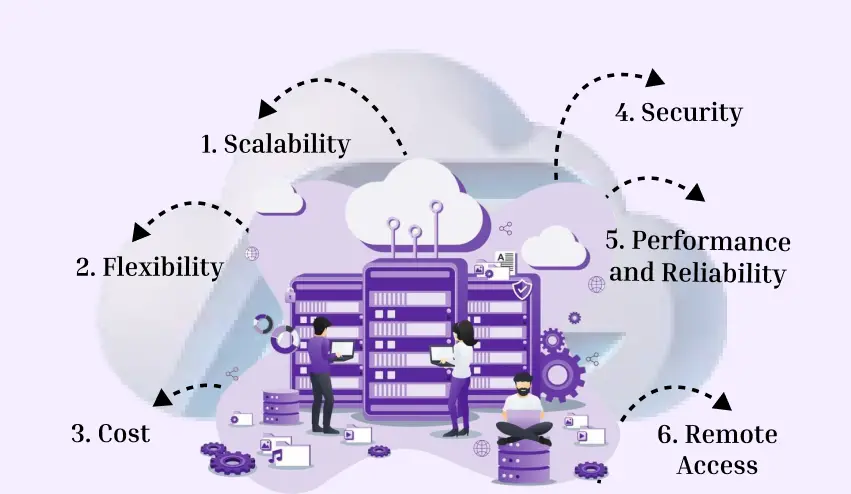
1. Scalability
As cloud hosting runs on virtual servers, it does not require the upgrade of the entire infrastructure to allot more computing resources. Instead, the scale of computing resources can be increased on demand. This helps to ensure that all business operations are running smoothly without raising any red flags. Moreover, additional resources in cloud hosting are added instantly, which results in preventing downtime.
2. Flexibility
Cloud hosting solutions do not restrict access to a single machine. Due to it running on a network of interconnected servers in a virtual environment, it can be seamlessly accessed from any remote location. Furthermore, it also offers excellent customization value, allowing businesses to tailor the infrastructure as per their unique requirements. These flexible hosting solutions allow businesses to adjust resources in real-time, making cloud infrastructure more adaptable than traditional hosting. You can also look for features like Cloud Run and Compute Engine for additional operational flexibility.
3. Cost
Despite the array of benefits that cloud hosting offers, the solutions do not fall in the costly category. Cloud hosting provides a pay-as-you-go feature in all deployment models. This feature ensures that there are no hidden charges and the business is only being billed for the resources that were actually consumed. As a result of this, you will be able to choose the right cost-effective hosting for your business.
Furthermore, there is also no upfront investment for physical hardware as the entire infrastructure is virtual-based. As for cloud monitoring and maintenance of the infrastructure, those tasks are handled by the cloud service provider. This not only further helps in saving IT costs, but also allows businesses to focus on more critical operations rather than worrying about infrastructure vitality.
4. Security
All cloud hosting models are integrated with enterprise-grade cloud security models, like firewalls, encryption, identity management, access control, and more. This helps to ensure that the business data remains safe and secure at all times. Also, check whether the provider has secure cloud data centers for additional security measures.
Moreover, even in case a disaster happens, the solutions also include automatic backups and disaster recovery features, ensuring that the crucial business data is always within recoverable reach. In addition to this, unauthorized access management is also provided, ensuring that no unauthorized user can access the infrastructure.
5. Performance and Reliability
Cloud hosting solutions provide a robust uptime of 99.99%, meeting SLA requirements of different businesses across various industries. As the solution runs on a network of interconnected servers, it also provides high reliability around the clock.
Moreover, the load-balancing model also ensures that the performance remains stable and consistent for any and all business operations performed on the cloud. This results in allowing businesses to perform day-to-day operations with maximum efficiency without any downtime.
6. Remote Access
One of the biggest benefits of cloud hosting is that the solutions can be seamlessly accessed from any remote location. Regardless of the location, both the performance and security remain optimal. This makes cloud hosting the most optimal choice for businesses that operate from or manage remote teams.
Furthermore, thanks to the authorized access control, users can only access the features that they have the authority to. This helps to prevent human errors, all the while promoting operational efficiency of a business.
How To Choose The Right Cloud Hosting Provider?
Even though cloud hosting offers a plethora of benefits, you can only unlock those for your business by working with a reliable Top cloud hosting providers. However, the task of choosing the right provider is much more complicated than it sounds. This is because there are a multitude of cloud providers in the market, not to mention that most of them have tagged themselves as the best. In order to ensure that you invest in reliable cloud hosting services, there are several factors that you need to consider.
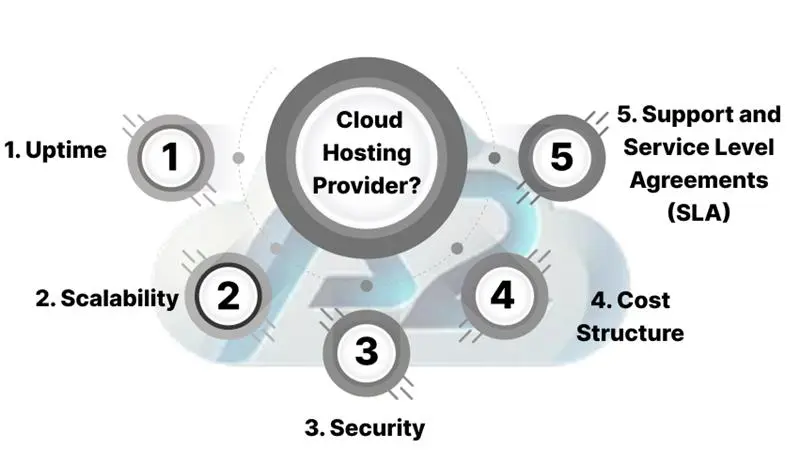
1. Uptime
Uptime determines how effectively you or your teams will be able to use the enterprise cloud solutions. 99.99% is the most reliable percent of uptime. Therefore, make sure that the provider is promising optimal uptime as well as response times. In order to check this, you will need to browse the provider’s performance metrics. Reliable uptime will ensure high availability with low downtime, ensuring continuity for all business operations.
2. Scalability
While cloud hosting solutions can be scaled, not all providers provide instant allotments, especially in shared hosting (making it one of the main causes behind the debate of cloud hosting vs shared hosting). Late scalability of resources can impact workflow performance, which, in turn, will influence long-term growth. Therefore, ensure that the provider is allowing you to instantly adjust the scale of resources without raising unnecessary downtime.
3. Security
Security is one of the major concerns that many businesses face when planning to move to the cloud. Cloud does not store data on a physical machine but on a network of servers. Compromising crucial data is easily one of the worst-case scenarios for any business. In order to prevent this from coming to life, make sure that the cloud servers of the provider are integrated with enterprise-grade cloud hosting security protocols.
Moreover, you will also need to check that their cloud optimization is meeting the regulatory compliance for your business niche to prevent raising any red flags. This makes cloud configuration management, along with the infrastructure management of your business, completely safe and secure.
4. Cost Structure
For cloud hosting vs dedicated hosting or cloud hosting vs VPS hosting, cost is one of the major factors that confuses many businesses. While the costs of all providers can differ significantly from one another, along with their services like basic cloud hosting and enterprise cloud hosting, this does not mean that you should choose the more costly one. More cost does not always equal better services. Instead, check whether the features are helpful for your business operations. Furthermore, also look for the pay-as-you-go model to prevent the cost from spiralling out of control.
5. Support and Service Level Agreements (SLA)
While cloud hosting offers a great deal of benefits, it is not exactly immune to errors. Whether the errors are raised internally or introduced in an update, you will need the support of the provider to address them. Therefore, make sure that the provider is offering a 24/7 reliable support system. Also, ensure that their SLAs highlight their commitments to the overall service quality. Additionally, also check for cloud migration services if you are planning cloud adoption.
Also read:- https://a2cloudhostingservices.com/cloud-hosting-for-small-businesses/
The Growing Importance of Cloud Hosting In The Digital World
Cloud hosting has become one of the most renowned solutions for businesses to safely and securely run their operations in a virtual environment. Moreover, as the infrastructure can also be accessed remotely, it ensures business operations continuity without causing downtime. Cloud hosting brings a plethora of benefits to the table, and businesses of different scales and niches can unlock them without having to install an on-premises machine. The answer to what is cloud hosting in simple terms is that it is a modern virtual solution that allows businesses to run their operations from any remote location with maximum efficiency, all the while being budget-friendly.
React out at +1(800) 217-0394 and discover the best managed cloud hosting solutions.
FAQs
What is a content delivery network?
Content Delivery Network (CDN) in cloud hosting is a geographically distributed network of servers, which is often called “edge servers,” that stores and shares cache copies of the data from the nearest server rather than the origin server.
What is serverless computing?
Serverless computing is a cloud hosting model where the provider completely manages the infrastructure. From updates and maintenance of virtual private servers (VPS) to virtual machines (VMs), all such tasks are handled by the provider. This helps businesses to focus on their operations without worrying about infrastructure health.
What are the different deployment models of cloud hosting?
There are three different types of cloud hosting platform deployment models. Public Cloud, this is also referred to as multitenant hosting or multicloud hosting, Private Cloud, commonly referred to as single-tenant hosting, and Hybrid Cloud, which combines the benefits of both Public and Private clouds.
What are the main benefits of cloud hosting?
The main benefits of cloud hosting include remote access, easy accessibility, seamless scalability, and optimal performance around the clock.
Is cloud hosting better than traditional hosting?
Cloud hosting is generally considered to be better than traditional hosting as it does not require installing an on-premises machine, and the infrastructure can be accessed virtually, all the while coming in at a budget-friendly price.

Brown Lopez is a Cloud Engineer and technical writer based in Austin, USA, who enjoys turning complex cloud ideas into clear, simple insights. With solid experience in cloud architecture and real-world projects, he loves creating practical content that helps professionals understand, build, and improve their cloud solutions with confidence.