
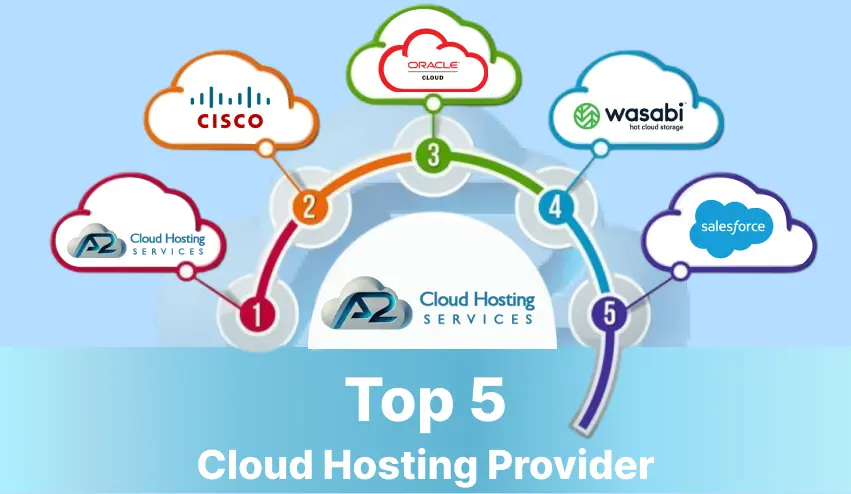
Choosing the right cloud hosting service providers in 2026 is no longer just about low pricing. Instead, it is about finding a balance between affordability, reliability, speed, as well as long-term value. Whether you are running a small-scale business or are a part of an established organization, relying on cloud infrastructure can be a budget-friendly option to deliver impressive performance without enterprise-level cost. Therefore, in this article, we will introduce you to the five best cloud hosting providers: A2 Cloud Hosting Services, Oracle Cloud Infrastructure, Salesforce, Cisco Cloud Solutions, and Wasabi.
Why Choose Affordable Cloud Hosting In 2026?
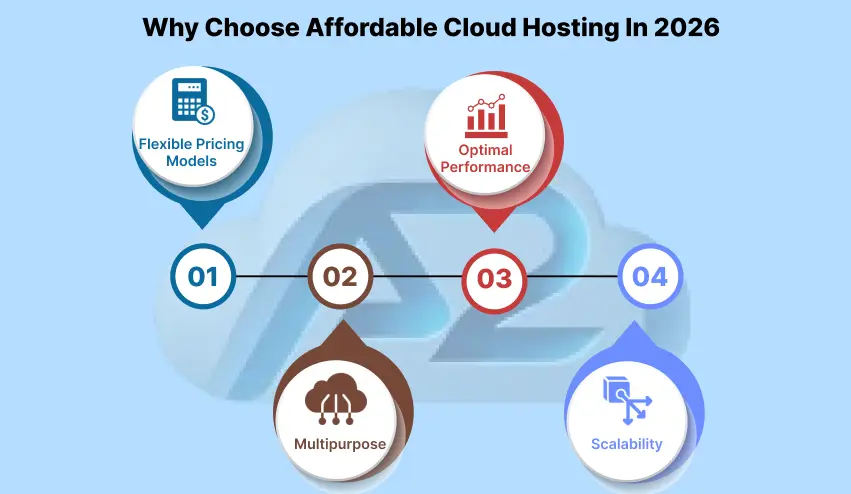
In 2026, affordable cloud hosting has become a smart decision for businesses as modern and best cloud hosting providers offer powerful infrastructure at competitive prices. This makes it easier for businesses of all scales to operate at high-performance infrastructures without overspending. The development of SSD-supported services, low-latency servers, and optimally designed global data centers implies that even low-cost cloud services can offer high-speed, reliable uptime.
Below, we have included some key reasons why affordable cloud hosting services make sense in 2026.
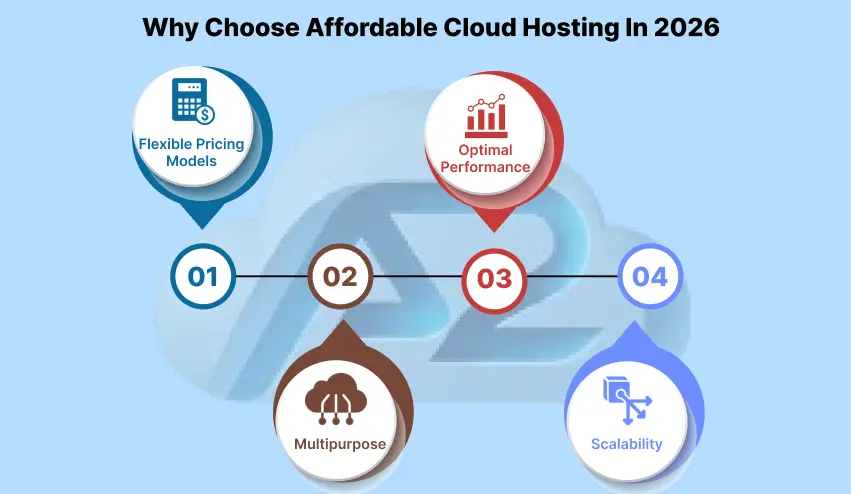
- Flexible Pricing Models: With most providers, you can have clear and transparent cloud hosting pricing. Moreover, the pay-as-you-go pricing model is also included, ensuring that you are only being billed for the resources that were actually consumed by your business.
- Scalability: In cloud hosting, you get the freedom to adjust the scale of resources as per your unique business requirements.
- Optimal Performance: As cloud hosting runs on multiple virtual servers, the load between the servers is equally divided. This provides optimal performance with little to no downtime.
- Multipurpose: Cloud hosting is not limited to a single type of website or a scale of business, as it can be used by startups, large-scale organizations, and even WordPress websites.
How We Tested Speed, Performance, and Value?

In order to make this cloud hosting comparison relevant and credible, we subjected ourselves to a systematic, practical testing scheme. All the providers have been considered in real-world scenarios to gauge their performance regarding daily users, startups, and expanding companies in 2026.
1. Speed Testing
Speed has a direct effect on the user experience, search engine optimization, and conversions, and therefore, it was a major consideration in our cloud computing review 2026. We experimented with the speed at which servers served and provided content at multiple locations.
We evaluated our speed, and it included:
- Server response time (TTFB) is a metric that evaluates how fast the server starts to respond with content.
- Page loading time on test websites using virtual cloud servers.
- Performance consistency across peak and non-peak hours
- Latency tests to test low-latency cloud servers for international visitors.
- Optimized networks and SSD hosting were always better in this category.
2. Performance Testing
In our performance testing, we focused on the stability and reliability of the affordable and top cloud hosting providers under different traffic conditions. We also did a simulation of a real-life application to determine how well each cloud server hosting solution can withstand stress.
During our testing, the key performance indicators were:
- CPU and RAM under load performance.
- Auto-scaling of traffic spikes.
- Load balancing resource distribution.
- Availability check on a long-term basis.
- Compatibility with different devices.
3. Value for Money
While the speed and performance testing helped us to shortlist cloud hosting providers, we also checked whether the services they offer can justify their price point or not. In this test, we checked cloud hosting prices, plan characteristics, and affordability in the long term.
In our value for money analysis, we considered:
- Plan and billing model transparency.
- Pay‑as‑you‑go options.
- Included security features of secure hosting.
- Ease of administration through the cloud control panel.
- Appropriateness to start-ups, small businesses, and developers.
Top 5 Most Affordable Cloud Hosting Providers in 2026
In our testing, we came to the conclusion that finding reliable yet affordable cloud hosting providers in 2026 is not just about comparing prices. Many providers advertise their services as “affordable”, but when checking them in detail, most of them often cut speed, stability, and scalability. Due to this, finding the right cloud hosting solutions can be a task that is much easier said than done, especially if you lack the technical knowledge or do not dig into the details. However, we were able to shortlist the top five most affordable cloud hosting service providers, and below, we have thoroughly discussed their services and what unique value they offer for your business.
1. A2 Cloud Hosting Services
A2 Cloud Hosting Services stood out in our test for delivering reliable and scalable cloud hosting services at an affordable price. A2 ensures stable and responsive server performance, unlike other providers that offer their services at a low price but compromise performance. This renders A2 as a reliable choice for users who want affordable but high-quality cloud infrastructure.
The thing that impressed us the most was that it involved speed-driven architecture. Based on the SSD-based storage and optimized server setup, A2 is highly-suited to projects that require immediate loading speed and smooth operation even on the entry-level cloud hosting plans. Additionally, it also effectively serves the interests of both technical and non-technical users as it is flexible in the management of the server.
The main features of A2 Cloud Hosting Services that stood out the most were:
- Highly optimized SSD cloud hosting designed for faster data access.
- Pay-as-you-go cloud hosting.
- Managed and non-managed hosting options.
- Compatible with multiple devices, Windows, macOS, and Linux.
- Consistent reliability and steady operation at times of traffic surges.
- An easy-to-use control panel to manage the servers.
2. Oracle Cloud Infrastructure
Oracle Cloud Infrastructure is a good option for users who want to prioritize infrastructure stability and performance without breaking the bank. In our tests, it provided stable uptime and robust backend reliability, particularly when data-intensive applications and enterprise loads are being targeted. Although Oracle is a little bit more complex than other lightweight platforms, it makes up for it with its wide range of features.
The cloud infrastructure provided by Oracle is based on strong virtual servers and developed networking, which is suitable for projects that require planned scalability, rather than immediate simplicity. Its price is competitive in the long-run application, particularly when it is coupled with the resource optimization and the pay-as-you-go flexibility.
The major features of Oracle Cloud Infrastructure are:
- Well-performing infrastructure made to work with a database-heavy workload.
- High availability cloud server hosting.
- Flexible pay‑as‑you‑go model
- High networker and security services.
- Virtual cloud servers for growing applications that are scalable.
3. Salesforce
Salesforce follows a somewhat different path than other traditional cloud hosting service providers because it is more concerned with application-level performance and integration. Nevertheless, it is reliable, has strong data security, and it can be scaled with ease in its own platform, which is unlike raw server customization.
However, instead of providing a profound server-level functionality, Salesforce focuses more on controlled hosting experiences that reduce the complexity of operation. This makes Salesforce an ideal cloud hosting solution for businesses that just want a dependable infrastructure without the technical server management headache. As for its performance, it remained constant, even in high-usage scenarios like CRM-driven and business-critical applications.
Key highlights of the cloud hosting services of Salesforce include:
- Minimum maintenance, fully managed cloud hosting.
- Good reliability with workloads that are application-focused.
- Automatic scalability without human resource modifications.
- Good standards of data protection and compliance.
- Perfectly suited to small businesses that operate under SaaS.
- Reduced control and monitoring via centralized dashboards.
4. Cisco Cloud Solutions
Cisco Cloud Solutions specializes in the provision of reliable infrastructure and gives priority to networking efficiency, security, as well as the management of traffic. The cloud environment of Cisco worked reliably at varying loads in our testing and is, therefore, a viable choice for businesses that need consistent connectivity and strong data transfers instead of brute force customization of their computers.
In contrast to developer-based cloud systems, Cisco lays great emphasis on the managed cloud systems and network optimization. This solution is advantageous to organizations that require secure cloud server hosting with built-in protection and limited downtime. Although its setup lies in the complex side, we can safely conclude that Cisco can contribute to stability in long-term performance and operational control.
The following are some of the highlights of Cisco Cloud Solutions:
- Good networking and traffic optimization strengths.
- Enterprise-level security on secure cloud hosting.
- Optimal performance in an extended working load.
- Reliability-based managed cloud infrastructure.
- Load balancing and scalable environment support.
5. Wasabi
During our testing process, Wasabi was clearly distinguished by other cloud hosting service providers due to its simple pricing and cloud-based services with a focus on storage. We also found that it does not attempt to compete in all categories of cloud but is focused on low-cost, high-performance cloud storage that is compatible with virtual cloud server environments, and surprisingly, it worked perfectly for Wasabi.
Performance was maintained in working with large amounts of data, making Wasabi a cost-efficient solution for backups, media hosting, and data-intensive workloads. Furthermore, its pricing system is also straightforward and predictable, and this aspect also serves to remove the confusion that is usually attributed to the traditional cloud hosting system.
The standout features of Wasabi we noted are:
- No complicated billing levels or level pricing.
- High-speed data transfer to cloud storage.
- Cost-effective cloud hosting for storage-heavy use cases.
- Good data durability and security protocols.
- Seamless integration with existing cloud server systems.
- Low management overheads.
Comparison Table – Affordable Cloud Hosting Providers 2026
Below, we have shared a detailed comparison table that highlights how each cloud hosting provider excels in different areas.
| Cloud Hosting Provider. | Performance Focus. | Speed & Latency. | Scalability Features. | Management Type. | Key Strength. |
| A2 Cloud Hosting Services. | High-performance workloads. | Fast response times with SSD infrastructure. | Easy vertical and horizontal scaling. | Managed & Unmanaged | Speed-optimized cloud environment. |
Oracle Cloud Infrastructure. | Stability and data-heavy operations. | Consistent latency across regions. | Structured, enterprise-grade scalability. | Mostly Unmanaged / Advanced Control. | Reliable infrastructure and security. |
Salesforce. | Application-level performance | Optimized within the Salesforce ecosystem. | Automatic scaling at the platform level. | Fully Managed. | Ease of use and ecosystem integration. |
Cisco Cloud Solutions. | Network reliability and uptime. | Optimized traffic handling. | Load balancing–focused scalability. | Managed Cloud Infrastructure. | Strong networking and security. |
Wasabi | Storage performance | High-speed data access. | Limited compute scaling, strong storage scaling. | Storage-Focused Managed Services. | Simple, high-performance cloud storage. |
To Conclude
Choosing the right cloud hosting solution in 2026 comes down to understanding your business requirements, performance, scalability, budget, and long-term goals. As modern cloud hosting service providers continue to evolve, even cost-conscious plans now offer stable infrastructure, strong security, and room to scale. Therefore, selecting the right cloud hosting option is not about paying more, but getting reliable performance and consistent value that aligns with your business goals.
FAQs
Can cheap cloud hosting services deliver good performance?
Yes, if the cloud hosting runs on SSD storage, optimized networks, and global data centers, then it can deliver consistent speed and reliability.
Which one is better managed or unmanaged cloud hosting?
If you want minimal technical involvement, then managed cloud hosting is ideal for you. However, if you want complete control over configurations and optimizations, then unmanaged cloud hosting is the way to go.
What is the difference between cloud hosting and shared hosting?
Cloud hosting provides computing resources from a virtual environment and supports flexibility and scalability. Shared hosting, on the other hand, requires you to share the virtual space with other tenants, and the resources are also limited.
Will cloud hosting be able to handle unexpected increases in traffic?
Yes, cloud hosting can handle unexpected traffic spikes as it runs on multiple virtual servers that are backed by a load balancing model. This model ensures that the load between each server is equally divided. As a result of this, you will see little to no downtime during sudden traffic spikes.
Can I migrate my website to cloud hosting?
Yes, you can migrate your website to cloud hosting either manually or by using the tools provided by the cloud hosting service providers.

Brown Lopez is a Cloud Engineer and technical writer based in Austin, USA, who enjoys turning complex cloud ideas into clear, simple insights. With solid experience in cloud architecture and real-world projects, he loves creating practical content that helps professionals understand, build, and improve their cloud solutions with confidence.